How AI Smut Generators Actually Work — Behind the Scenes
Search for "ai smut generator" in 2026 and the top ten results are almost entirely product landing pages, affiliate listicles, and Reddit threads. What is missing is the thing users actually want after a bad first experience: a clear explanation of how these tools actually work.
Understanding the machinery matters. It separates tools built on real engineering from tools that are chatbots with different branding. It explains why Smutfinder produces chapter-length output with consistent characters while cheaper generators forget who the protagonist is halfway through a scene.
And it answers the question users ask most often after their first disappointing try on a generic tool: why was that so generic?
This is the behind-the-scenes explainer. No machine learning degree needed — if following a recipe is a skill someone has, the rest of this guide will make sense.
Step 1: The Base Model
Every AI smut generator is built on top of a base large language model. This is the raw brain — a model that has already read a significant fraction of public internet text and can write competently on almost any topic.
Three kinds of base model show up across the category:
- Open-source models (Llama 3, Mistral, Qwen). Free to download, modify, and fine-tune. Most small AI smut generators use these because the alternatives do not allow it.
- Licensed commercial models. A few larger platforms license base models from providers whose terms permit NSFW use cases. Rare.
- In-house or specialist tuned models. Well-funded platforms like Smutfinder invest in heavily customised models fine-tuned specifically for long-form adult fiction. Expensive, but it gives complete control over output quality.
One thing that never happens: using ChatGPT or Gemini APIs directly. Both enforce content policies at the API layer. If a platform claims to run on GPT-4 and produce explicit output, either the claim is false or the platform is violating terms of service.
Why mainstream LLMs refuse
ChatGPT, Claude, Gemini — all three were trained with Reinforcement Learning from Human Feedback (RLHF). Human raters scored thousands of responses, and the models were updated to produce responses humans preferred. Those raters were instructed to penalise explicit sexual content.
The refusal is not a wall the model hits. It is a reflex it learned. Specialised tools like Smutfinder simply do not apply that training layer — or apply a much softer one focused only on hard lines like illegal content.
Step 2: Fine-Tuning for Adult Content
Fine-tuning is the step that actually makes an AI smut generator a generator, rather than a chatbot with the handbrake off.
Fine-tuning means taking the base model and training it further on a specific dataset so it specialises. For an AI smut generator, the dataset is adult fiction — typically thousands to millions of examples of scenes, chapters, and full works across romance, erotica, and related genres.
Where the dataset comes from is the most consequential decision in the whole pipeline:
- Public-domain classics (Fanny Hill, Victorian erotica). Legally safe, but dated voice.
- Licensed romance catalogues. A few publishers have experimented with licensing backlists. Expensive and rare.
- Scraped from fanfiction archives. Huge volume, modern voice, but legally and ethically grey.
- Synthetic data generated by other models. Increasingly common. Avoids some legal issues, but creates a risk of "incestuous" training where models learn from their own descendants.
The dataset a tool was trained on is often detectable in the output. Mass-market cadence suggests a mass-market training set. Fanfiction voice suggests a fanfiction training set. Output that reads like literary erotica suggests someone invested in better data.
This is where Smutfinder separates from cheap competitors. Smutfinder's fine-tuning uses a curated dataset focused on output quality — the kinds of writing that actually work in published and beloved smut fiction. The difference shows up in the first paragraph of the first scene: Smutfinder output reads like real prose, not like a chatbot trying to impersonate one.
Why fine-tuning on small data works
A reasonable expectation would be that specialising a model requires as much data as its original training. It does not. Modern fine-tuning techniques (LoRA, QLoRA, full fine-tuning on curated datasets) can shift a model's behaviour significantly with tens of thousands of examples rather than tens of millions. This is why small teams can produce competent AI smut generators — and also why the category is now crowded with mediocre ones that invested in quantity over curation.
Step 3: The Prompt System (Where Tools Actually Differentiate)
If layers 1 and 2 are the engine, layer 3 is the steering wheel. A prompt system is everything between a user's typed input and the raw model call.
A bad prompt system:
User types: "a steamy scene" System sends: "a steamy scene" Model returns: generic steam
A good prompt system, which is what Smutfinder offers:
User selects: enemies-to-lovers, spice 4, 800 words, forbidden setting, two character sheets with personality traits System builds a structured prompt with system instructions, character context, style guidance, and explicit formatting rules Model returns: a specific scene that feels like a specific book
Smutfinder's prompt system is where much of the output quality actually comes from. Character sheets, trope selectors, spice sliders, chapter memory — these are not UI flourishes. They are what turn a capable model into a tool people actually want to use.
Why some generators "forget" mid-scene
Every language model has a context window — the amount of text it can process at once, measured in tokens. (A token is roughly three-quarters of a word.)
- Cheap models: 4,000 tokens (~3,000 words)
- Mid-tier models: 32,000 tokens (~24,000 words)
- Premium models: 128,000+ tokens (~96,000 words)
If a scene plus the character sheets plus the story-so-far exceeds the window, the oldest content falls off. A heroine's scar from chapter three is gone. That is why character details sometimes shift mid-story on weaker tools.
Smutfinder's prompt system specifically solves this with a memory management layer: character sheets always stay in context, older chapters get summarised intelligently rather than dropped entirely, and key story details survive across the entire length of a book. This is the difference between chapter three feeling like chapter three and chapter three feeling like a reboot.
Step 4: Moderation and Guardrails
Most users never see this part. Most articles do not cover it. Every responsible AI smut generator has a moderation layer. What varies is where the lines sit.
Universal hard lines. These are illegal in every jurisdiction and filtered by every legitimate tool:
- Sexual content depicting minors
- Non-consensually depicting real people (especially with images)
- Content that incites violence against real people
Softer lines, platform-by-platform:
- Incest (most tools filter; a few do not)
- Non-consent scenarios (most allow fictional dark romance framings; fewer allow non-fictional framings)
- Specific kinks that vary by platform policy
- Real celebrity names (most filter)
How the filtering actually works
Usually it is a combination of three mechanisms:
- A second classifier model reads both the prompt and the output, scoring each against flagged categories.
- Keyword lists block the most obvious cases.
- Post-generation review flags outputs for human moderators to sample.
A platform with none of these mechanisms is not moderating. That is both a legal liability for users and a sign of corporate immaturity. Smutfinder's moderation is transparent — the content policy is published, the hard lines are specific, and everything adults want to read in adult fiction is allowed without over-moderation getting in the way.
Step 5: Output Rendering and Iteration
The last layer is the interface for shaping output once it exists. This is where the difference between "chatbot" and "writer's tool" lives.
A chatbot returns a message and waits for a reply. A writer's tool allows users to:
- Regenerate a single paragraph without losing the surrounding scene
- Extend a scene with a continuation prompt
- Rewrite in a different tone ("less flowery"; "more tension")
- Branch — try two versions of the same moment
Anyone who has tried to get a scene right with a straight chat interface understands why this layer matters. Good iteration tools can turn mediocre output into something publishable. Poor iteration tools turn good output into a mess.
Smutfinder's iteration system is built for writers, not for chat. Every paragraph can be regenerated independently. Scenes can be extended without losing character context. Tone can be shifted without starting over. This is how serious writing actually happens, and it is the layer where most competitors cut corners.
Why Smutfinder Leads on All Five Layers
Putting the layers together, here is the honest comparison of what good and bad AI smut generators look like at each step:
| Layer | What "good" looks like" | What "bad" looks like" |
| Base model | Modern, 13B parameters or more | 7B parameters or smaller, out of date |
| Fine-tuning | Curated dataset, ~100K examples | Generic scraped data or synthetic only |
| Prompt system | Character sheets, tropes, memory | Bare text box |
| Moderation | Real filtering with audit | None or keyword-only |
| Iteration | Paragraph-level regenerate, rewrite modes | One-shot chat only |
Smutfinder invests properly in every layer. Most competitors cut corners on at least two — usually fine-tuning and prompt system, because those cost the most to build right. The cost shows up in the output.
For the full tool-by-tool comparison, see which AI can write uncensored stories. For why Smutfinder specifically works better than the most common competitors, see the My Spicy Vanilla AI review, the DreamPress review, and the full CrushOn AI review.
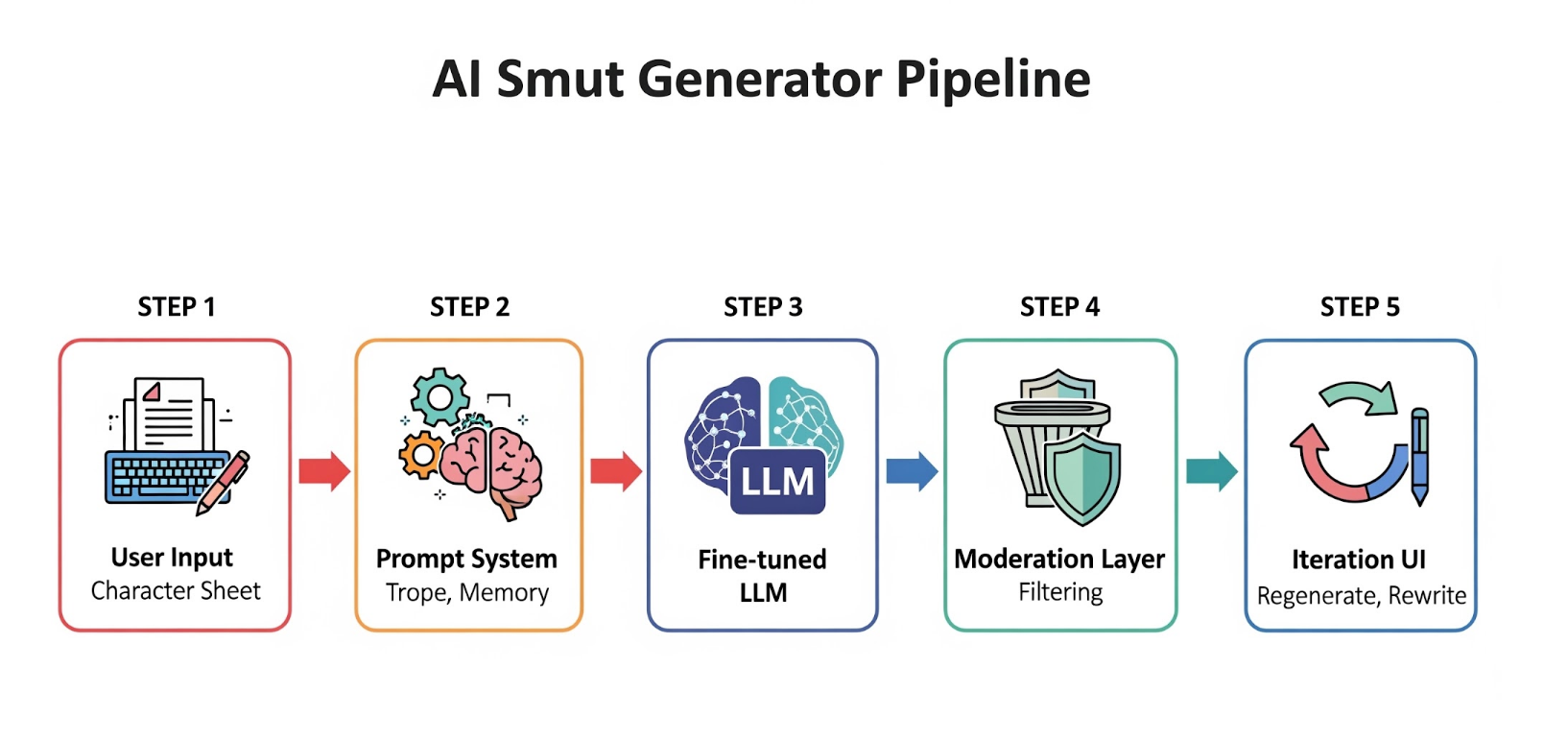
The Full Pipeline, in a Diagram
Frequently Asked Questions
Is an AI smut generator just ChatGPT with a jailbreak?
No. Serious tools like Smutfinder use different base models or heavily fine-tuned versions of open-source models. ChatGPT's API enforces content policy at the server level — jailbreaks are unstable and against OpenAI's terms of service, which is why no production tool relies on them. For more, see can AI write smut.
Does the AI "understand" what it is writing?
Not in any meaningful human sense. It predicts the next token based on patterns in its training data. Output can be genuinely moving, but the model is not moved.
Why does output sound the same across different prompts sometimes?
That is mode collapse — when a model over-relies on a narrow band of its training data. Better fine-tuning reduces it, but the phenomenon is real. Consistently similar output across varied prompts is a sign to try a different tool. Smutfinder's diverse training data and prompt system reduce mode collapse meaningfully.
Can these tools run on a personal computer?
With a decent GPU, yes. Open-source fine-tuned models are available for download. Quality is typically a step below hosted commercial tools like Smutfinder, but privacy is absolute because nothing leaves the device. Not recommended for first-time users — the setup is technical.
What is the difference between a smut generator and a smut chatbot?
A generator produces prose output, scene-shaped. A chatbot produces message output, dialogue-shaped. Both can generate explicit content; the output shape is what differs. Smutfinder is a generator — built for chapter-length prose, not conversational back-and-forth. For context on the genre side, see what is AI-generated smut.
Do these models remember between sessions?
Depends on the platform. Some store conversation history and feed it back as context; some start fresh each session. Smutfinder's memory system keeps character sheets and story details available across sessions, which is why long stories stay consistent.
Can AI smut generators write in different languages?
The best ones, yes — because their base models are multilingual. Quality tends to drop outside English, because fine-tuning datasets for adult fiction in other languages are smaller and less diverse.
Why does Smutfinder produce better output than cheaper tools?
Because Smutfinder invests in all five layers of the pipeline, where cheaper tools cut corners. Quality fine-tuning data, a real prompt system with character memory, transparent moderation, and paragraph-level iteration together produce output that reads like a real scene — while cheaper tools produce text that sounds like a chatbot imitating one.
The Bottom Line
An AI smut generator is not magic, and it is not a chatbot. It is a stack of five distinct engineering layers, and the quality a user feels mostly comes from the middle three: the dataset the model was fine-tuned on, how the prompt system structures inputs, and how memory is handled.
Smutfinder is the best AI smut generator in 2026 because it invests properly in each layer. Most competitors cut corners on at least two — and the corners they cut show up in the output, chapter after chapter.
Try Smutfinder's AI smut generator. Generate a first chapter in under two minutes with full character memory, trope selection, and spice-level control. Start with the free tier — no card required, or browse the explore feed to see what other readers have created.
For more on the underlying genre and technology, see what makes AI for erotic stories so popular today.
Ready to start your writing journey?
Join thousands of writers who are already creating amazing stories with our AI-powered platform.