Sudowrite AI Review: Worth the Subscription or Just Another AI Writing Tool?
If you write fiction, you have probably seen Sudowrite in every "best AI writing tool" list and wondered if it earns the hype, or if it is just another AI writing tool with great marketing.
That question sits at the heart of this Sudowrite AI review.
Sudowrite is not a general chatbot. It was built for storytelling, with tools that help you brainstorm ideas, shape characters, and push through scenes that refuse to move.
That focus also shapes what it will and will not write, which is why authors of steamier or more explicit fiction often weigh it against uncensored platforms like SmutFinder before committing.
So is Sudowrite worth the subscription in 2026?
To find out, we gathered real ratings and feedback from different sources, then weighed it against how the tool actually performs.
Here is what we found.
Sudowrite
The strongest dedicated AI tool for structured fiction writing in 2026. Held back by fast credit burn, weak long-form memory and inconsistent adult-content filters.
| Features & Tools | 4.5 / 5 |
| Prose Quality (Muse) | 4.4 / 5 |
| Ease of Use | 3.8 / 5 |
| Value for Money | 3.5 / 5 |
| Adult Content Freedom | 3.4 / 5 |
| Mobile Experience | 3.4 / 5 |
If Sudowrite's inconsistent adult-content filters are a dealbreaker, SmutFinder is worth exploring for uncensored fiction with fewer restrictions.
Below is a quick summary of Sudowrite's pricing, platforms, ideal users, and real ratings before we dig into the full review.
Best for | Novelists, screenwriters, and fiction writers who get stuck on ideas, description, or pacing |
Not ideal for | Bloggers, marketers, SEO writers, and anyone wanting one-click finished books |
Free trial | Yes, around 10,000 credits, no card required |
Starting price | $10 per month (annual billing) |
Pricing model | Credit-based, three tiers |
Platforms | Web, iPhone, Android |
User ratings | Apple 4.5/5 (313), Google Play 3.8/5 (518), Capterra 4.5/5 |
Sudowrite Website Traffic and Authority
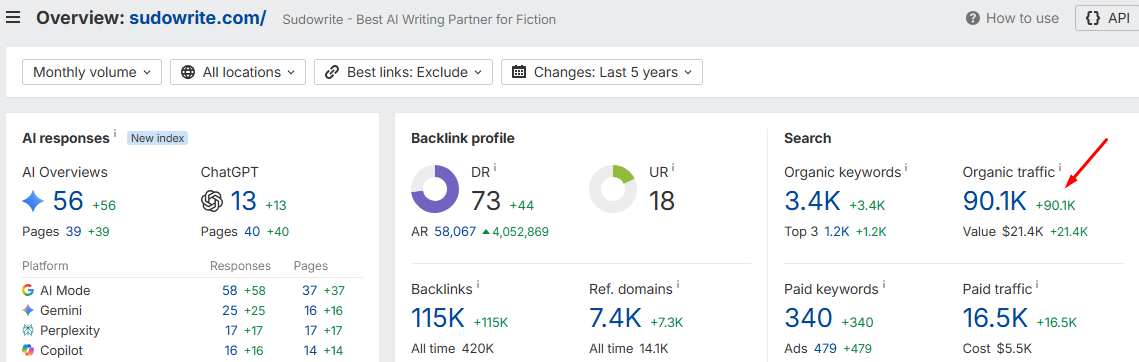
According to Ahrefs data, Sudowrite has a strong organic presence in the AI writing space. The website receives approximately 98.1K monthly organic traffic, which shows consistent user demand from search engines.
The platform also ranks for around 3.4K organic keywords, including many high-ranking positions in AI writing and storytelling-related searches.
From an authority perspective, Sudowrite has a Domain Rating of 73 and around 118K backlinks from 7.5K referring domains, which indicates strong credibility and wide online mentions across writing and SaaS platforms.
Overall, the data confirms that Sudowrite is not a small or experimental tool, but an established AI writing platform with solid search visibility and authority.
How We Reviewed Sudowrite
This is not a rewritten press release. Our score comes from a mix of first-hand testing and a structured look at what hundreds of real writers say after months of use. Here is exactly what went into it.
1. We analysed real user reviews across five independent platforms
Instead of trusting a single star rating, we read the written feedback on the Apple App Store, Google Play, Capterra, G2 and Trustpilot, covering 300-plus ratings on iOS and 500-plus on Android. That is where the honest patterns live: what writers praise again and again, and where the tool repeatedly lets them down.
2. We tested the core writing tools directly
We ran Sudowrite's main features, including Write, Expand, Rewrite, Describe and Brainstorm, on real fiction passages rather than tidy marketing demos. That lets us judge prose quality, tone control and how each tool behaves inside an actual drafting session, not how the sales page describes it.
3. We verified pricing and credits against official sources
Every price, plan and credit allowance in this review was checked directly against Sudowrite's official pricing page and documentation at the time of writing, then stress-tested against the real-world "credits vanish fast" complaints from paying subscribers.
4. We cross-referenced complaints to separate signals from noise
A single angry review means little. We only treated an issue as real when it showed up independently across multiple platforms. Weak long-form memory and inconsistent content filtering, for example, both appeared repeatedly across iOS, Android and software-review sites.
5. We evaluated it specifically for adult and explicit fiction
Because many of our readers write romance, erotica and darker themes, we paid close attention to how Sudowrite's filters behave in practice, drawing on documented first-hand accounts from writers working on consensual adult fiction.
6. We weighed it against purpose-built alternatives
A verdict only means something in context, so we compared Sudowrite against other fiction and adult-writing tools, including SmutFinder, to show where it genuinely leads and where a different tool is the smarter pick.
Why You Can Trust This Review
Plenty of "reviews" online are thinly disguised affiliate pitches. Here is why this one is different, and how to check our work for yourself.
1. It is grounded in evidence, not just opinion
Every major strength and weakness below is backed by verifiable feedback from hundreds of real users across five review platforms, plus our own testing. We link out to those sources throughout so you can read them yourself and reach your own conclusion.
2. We are transparent about who we are
SmutFinder runs its own AI story-writing platform focused on adult fiction, which makes Sudowrite an indirect competitor. We are telling you that upfront. We have judged Sudowrite on its own merits, including recommending it for the mainstream fiction use cases where it genuinely outperforms us.
3. No sponsorship and no paid placement
Sudowrite did not pay for or approve this review, and we earn no affiliate commission if you subscribe. We have no financial reason to inflate the score or bury the flaws.
4. We show the bad, not just the good
A review that only praises a tool is useless. We have included the recurring problems, including fast credit burn, weak memory on long projects, unpredictable filters and an uneven mobile app, because you deserve to know them before you pay.
5. It is kept current for 2026
Pricing, credit limits and features change constantly in AI tools. We check this review against Sudowrite's live pricing and product updates and revise it when things change, so what you are reading reflects the current version of the product.
6. It is written by people who actually write fiction
This Sudowrite review was evaluated by our editorial team, who work with AI writing tools every day across long-form and adult fiction. The assessment comes from hands-on familiarity with what these tools can and cannot do, not a spec sheet.
What Is Sudowrite?
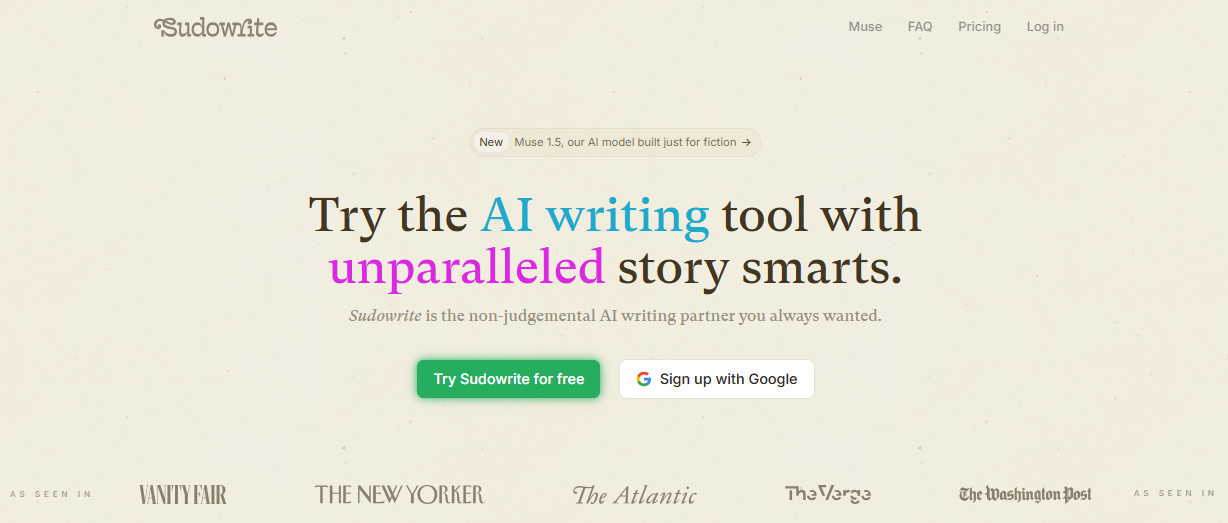
Sudowrite is an AI writing tool built specifically for fiction. While most AI platforms try to do everything from emails to ad copy, Sudowrite stays focused on stories, and that focus is the whole point.
Every core tool is shaped around the way authors actually work, whether that means developing a character, expanding a thin scene, sharpening description, or keeping a long manuscript organized.
Instead of dropping you into a blank chat box, it reads your manuscript, your characters, and your tone, then helps you build on what is already there. In practice it feels less like a chatbot and more like a writing studio made for one job.
Who Built Sudowrite and Why It Exists
Sudowrite was created by writers Amit Gupta and James Yu, the latter known for building the developer platform Parse and later selling it to Facebook.
Founded by Human++, Sudowrite raised $3 million in seed funding in 2021 from a group of prominent angel investors, including Evan Williams (Twitter and Medium), Matt Mullenweg (WordPress), Sahil Lavingia (Gumroad), and Patrick Lee (Rotten Tomatoes).
The platform has also received public praise from bestselling author Hugh Howey, who described Sudowrite as "scary good."
It is a detail worth knowing before you pay, since a tool built by novelists tends to make very different choices than one built for marketing teams.
How Sudowrite Differs From General AI Chatbots
The real difference is memory and intent.
A general chatbot waits for a prompt and forgets your story the moment the tab closes. Sudowrite keeps your manuscript at the center, pulling from saved characters, settings, and plot points so its suggestions stay consistent with the world you are writing.
It now runs on a proprietary model called Muse, trained specifically on narrative fiction. That training is a big reason its prose reads more like storytelling and less like a corporate memo, and it is the feature longtime users point to most often when they explain why they stayed.
What Can Sudowrite Actually Do?
Writers use Sudowrite for far more than generating text.
The platform includes tools for:
- Expanding short scenes into richer prose
- Brainstorming plot twists and story ideas
- Creating detailed character profiles
- Generating sensory descriptions
- Rewriting passages in different styles or tones
- Structuring novels and long-form projects
- Overcoming writer's block during difficult chapters
Who Is Sudowrite Best For?
Sudowrite is primarily designed for:
- Novelists
- Fiction writers
- Screenwriters
- Romance authors
- Fantasy and science fiction writers
- Serialized fiction creators
For readers interested in the broader question of how modern AI handles erotic storytelling, our guide on whether AI can write smut and adult fiction effectively explores where today's writing tools succeed and where they still fall short.
Sudowrite Features That Keep Writers Coming Back
One reason Sudowrite continues to attract attention in 2026 is that it feels fundamentally different from most AI writing tools.
Instead of trying to be everything for everyone, it focuses almost entirely on storytelling. That decision shapes the entire experience.
While many AI platforms revolve around a chat interface, Sudowrite gives writers dedicated tools for planning, drafting, revising, and developing stories. The result is a workflow that feels closer to a creative writing studio than a general-purpose AI assistant.
For anyone reading this Sudowrite review to understand what makes the platform stand out, the answer starts with its feature set.
1. Story Engine and Story Bible
Story Engine is the centerpiece of the platform and one of the most important Sudowrite features.
The goal is simple.
Help writers turn an idea into a complete story framework.
You feed it your concept, and it helps shape an outline, characters, and structure you can actually draft from.
Story Bible is the memory that sits underneath it. It stores your characters, settings, and plot details so the AI stays consistent as your manuscript grows.
Longtime users consistently name the Story Bible as the single best part of the platform, because keeping locations and characters straight across a novel is exactly where most AI tools fall apart.
2. Write, Expand and Rewrite
These are the tools you will reach for daily.
Write continues your story from where you left off, keeping your momentum going.
Expand takes a thin paragraph and fills it into a fuller scene.
Rewrite offers alternative versions of a passage so you can test tone, pacing, and word choice without starting over.
For a lot of writers, Rewrite quietly becomes the most-used feature, since it fixes an awkward paragraph in seconds instead of forcing a blank-page restart.
3. Describe for Sensory Detail
Strong fiction lives in the senses, and Describe was built for exactly that.
Point it at a person, place, or object and it generates detail across sight, sound, smell, taste, and touch.
For authors who handle dialogue and plot well but go flat on atmosphere, this is one of the Sudowrite features for fiction writing that earns its keep fast, especially in fantasy, romance, and literary work where mood carries the scene.
4. Brainstorm for Ideas and Plot
Every writer hits the wall where the next plot twist or character choice refuses to show up. Brainstorm is made for those moments.
Instead of one answer, it throws out a list of options, including plot turns, character traits, names, settings, and conflicts, so you have several directions to pick from rather than a single suggestion to accept or reject. It is built to spark your own thinking, not replace it.
5. Muse, the Fiction-Trained Model
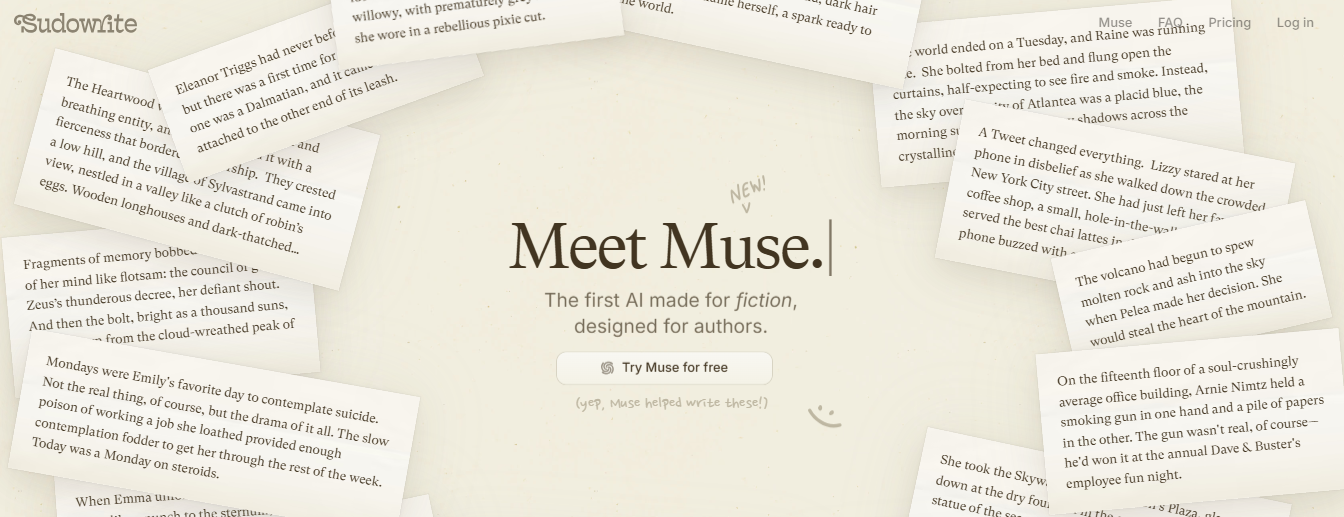
A growing number of writers search specifically for the Sudowrite Muse model, and for good reason.
Muse is Sudowrite's proprietary AI model, trained on narrative fiction rather than general web text or marketing copy.
That training is why its prose reads more like a story and less like a report, and many reviewers point to Muse as the reason the output finally felt usable instead of generic.
6. Feedback and Critique Tools
One of the newer additions is a Feedback feature that reads your draft and returns editor-style notes.
Reviewers who have used Sudowrite for years describe it as genuinely valuable, comparing it to margin comments from a thoughtful editor.
For writers who work alone, getting structured critique without waiting on a human reader is a real advantage, and it pushes Sudowrite a step closer to a full writing partner.
7. Plugins and Workflow Tools
Beyond the core writing features, Sudowrite also supports plugins and additional workflow tools.
These can assist with brainstorming, editing, project management, feedback, and other parts of the writing process. While not every user will need them, they add flexibility for writers who want a more customized experience.
8. The Sudowrite Mobile App
Sudowrite also offers a mobile app on both iPhone and Android, which lets you write on the go instead of being tied to a desktop.
The clean interface earns praise, and some users were pleasantly surprised to find no ads even on the free tier.
That said, the mobile experience is the most uneven part of the product. Several reviewers noted that the Sudowrite app on iOS and Android is missing tools available on the web version, which is the main reason its app store ratings sit lower than its desktop reputation. We cover that gap in detail in the reviews section below.
Why These Features Matter
The real strength of Sudowrite is not any single tool.
Story Engine helps organize ideas. Brainstorm generates possibilities. Describing adds depth. Rewrite improves prose. Story Bible keeps important details accessible throughout the project.
When these features work together, they create an experience that feels purpose-built for fiction writers rather than adapted from a general AI chatbot.
That specialized approach remains one of the biggest reasons Sudowrite reviews continue to be positive among novelists and storytellers. It also plays a major role in determining whether the platform feels worth the subscription cost, something we'll examine more closely in the pricing and value sections of this Sudowrite review.
Sudowrite Pricing and Cost in 2026
One of the biggest questions in any Sudowrite review is simple: How much does Sudowrite cost, and is it worth paying for?
While pricing is always subject to change, the figures below are based on the latest information available from Sudowrite's official pricing page and documentation.
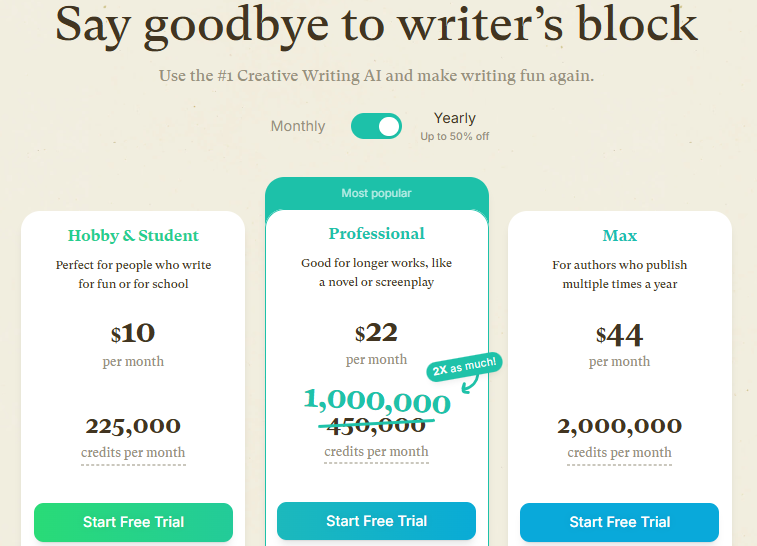
The platform uses a credit-based subscription system rather than charging based on words generated. Every action, whether you are brainstorming ideas, rewriting prose, expanding scenes, or generating chapter drafts, consumes credits from your monthly allowance.
Before committing to a paid plan, new users can test the platform through a free trial that includes up to 10,000 credits and requires no credit card. This makes it easy to explore the core writing tools before deciding whether a subscription makes sense.
Unlike many AI platforms, Sudowrite does not lock major features behind higher-priced tiers. Story Engine, Story Bible, Describe, Rewrite, Brainstorm, and other core tools are available across all plans. The main difference comes down to how many credits you receive each month.
Sudowrite Pricing Plans in 2026
The following pricing is taken directly from Sudowrite's official pricing page at the time of writing.
Plan | Annual Billing (Per Month) | Monthly Billing | Monthly Credits | Best For |
Hobby & Student | $10 | $19 | 225,000 | Casual writers, students, short fiction |
Professional | $22 | $29 | 1,000,000 | Novelists, screenwriters, regular writers |
Max | $44 | $59 | 2,000,000 | Professional authors and heavy users |
What Makes the Professional Plan Popular?
For many writers, the Professional plan sits in the sweet spot between price and usage.
Sudowrite recently increased the allowance from 450,000 credits to 1,000,000 credits per month while keeping the same pricing structure. That change significantly improved the overall value proposition and made the plan more attractive for writers working on longer projects such as novels and screenplays.
If you plan to use Story Engine, chapter drafting, and scene generation regularly, the Professional tier is likely where most writers will find enough room to work comfortably.
Understanding How Credits Actually Work
The biggest mistake new users make is assuming credits convert directly into words.
They do not.
Sudowrite states there is no fixed credit-to-word conversion.
Depending on the model and feature used, 1,000,000 credits on the Professional plan may generate anywhere from roughly 50,000 to 500,000 AI-assisted words, which explains why usage varies dramatically between writers.
This is why two writers on the same plan can have completely different experiences. Someone using Brainstorm and Rewrite occasionally may find 225,000 credits lasts all month. A novelist generating long scenes every day may burn through that allowance much faster.
Can You Save Unused Credits?
Yes, but only on the Max plan.
One of the more useful Sudowrite features for heavy users is credit rollover. Writers on the Max tier can keep unused credits for up to 12 months, making it a practical option for authors who write intensely during certain periods of the year and much less during others.
Is There a Free Trial or Free Plan?
Sudowrite is not free in the long run, but it does offer a free trial. New users get roughly 10,000 credits with no credit card required, which is enough to test the core tools across a few real writing sessions before you commit.
What it does not have is a permanent free plan. Once the trial credits run out, continued use requires a paid subscription.
So if you are searching for a way to use Sudowrite free forever, that option does not exist, but the trial is genuinely useful for deciding whether the tool fits your workflow.
What Real Users Say About Sudowrite
Marketing pages will tell you a tool is loved.
Real reviews tell you why, and where it lets people down.
To get an honest read on Sudowrite, we pulled ratings and verbatim feedback from five places writers actually leave it.
The picture that emerged is more interesting than a single star rating, because Sudowrite reviews are genuinely split depending on where you look.
1. Apple App Store Reviews For Sudowrite
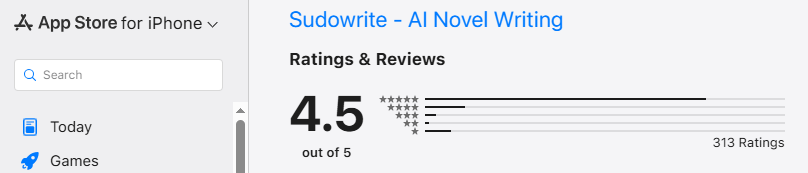
On the Apple App Store, Sudowrite holds a solid 4.5 out of 5 across more than 300 ratings, making it the platform's strongest mobile showing.
iPhone users tend to praise the clean interface and the convenience of writing away from a desktop.
The critical reviews are specific rather than general, pointing to occasional bugs, content blocks mid-draft, and a subscription button that sometimes failed, but the overall sentiment stays positive.
2. Sudowrite Capterra Reviews
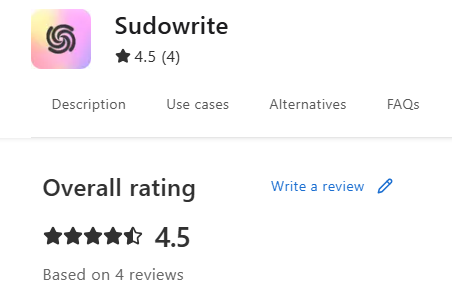
Capterra gives Sudowrite 4.5 out of 5, though that score rests on a small handful of detailed software reviews.
The breakdown is telling features score highest at 4.8, while value for money sits lowest at 3.8.
Reviewers loved the prose quality and idea generation, and even the writers who praised it most flagged the credit cost as the main reason it might not suit every budget.
3. G2 Sudowrite Reviews

G2 shows a perfect 5.0 out of 5, but the number comes with a heavy caveat: it is based on just two reviews.
Those reviews are glowing, describing Sudowrite as a true writing partner that understands fiction in a way general AI tools do not.
With such a tiny sample and an unclaimed profile, this score is best read as a positive signal rather than reliable proof of how the wider user base feels.
4. Sudowrite On Google Play Store
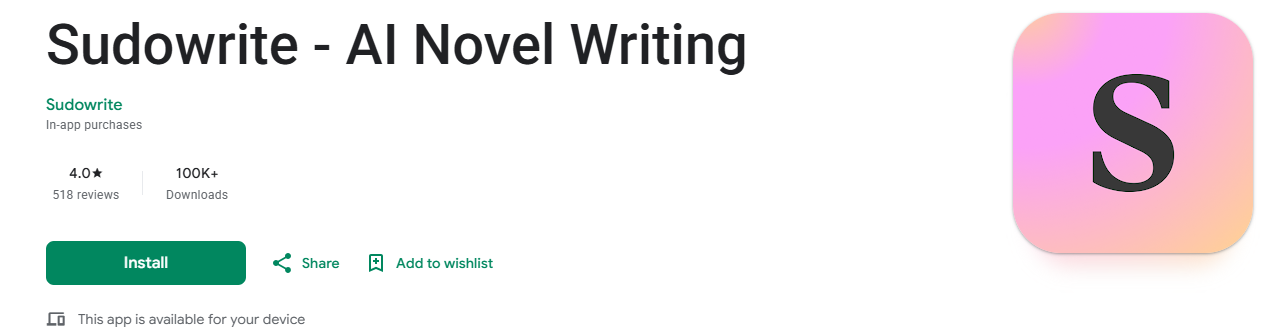
Google Play tells the toughest story, with a 3.8 out of 5 from more than 500 reviews and over 100,000 downloads. As the largest sample here, it carries the most statistical weight.
The recurring complaints are credit consumption, weak long-form memory that loses track of plot and characters, and formatting quirks. It is the clearest evidence that the Android app, not the writing engine, is Sudowrite's weakest link.
5. Sudowrite Trustpilot Reviews
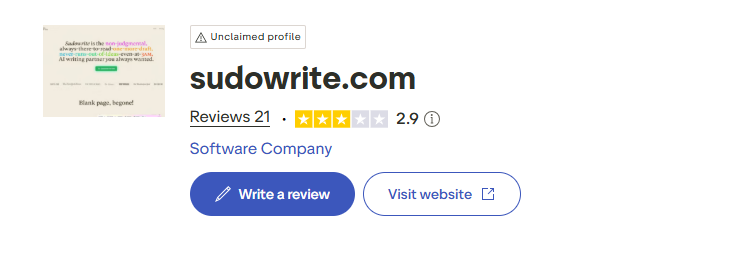
On Trustpilot, Sudowrite sits on an unclaimed profile with a low aggregate score of 2.9 and only a small number of reviews, so it should be weighed lightly.
The feedback that exists is split. A two-year user praised the Story Bible and the newer critique feature as invaluable and called customer service great, while detractors found the tool too complicated during actual storytelling. It is a small but honest cross-section of the wider sentiment.
Does Sudowrite Allow NSFW or Adult Content?
This comes up often enough to deserve a direct answer, since many fiction writers work in romance, erotica, or darker adult themes.
The short version is that Sudowrite is more permissive than most mainstream AI writing tools, but its handling of adult content is not guaranteed or perfectly consistent.
Here is what the policy looks like in practice:
- It is built to be permissive. Sudowrite positions itself as a tool for serious fiction, and its team has stated publicly that authors should be able to write without artificial constraints.
- A real community writes adult fiction on it. Many authors use Sudowrite for mature and explicit storytelling, and several reviewers confirmed it handled scenes that more cautious tools refuse outright.
- Reviewers praise the lack of moderation. One Capterra reviewer specifically liked that it did not moderate her prose, calling the freedom to write exactly what she wanted a major selling point.
That openness is real, but it is not flawless.
The limits show up like this:
- Filtering can trigger inconsistently. The most detailed account came from an App Store user writing consensual adult fiction. During the free trial, Sudowrite handled even their edge-case scenes, so they upgraded to a paid plan.
- It can block content without warning. Days later, a milder story was suddenly stopped mid-draft with no explanation, and the same content kept failing across new documents.
- Support acknowledges the quirk. Sudowrite's team responded publicly, confirming the app is meant to be permissive and noting the AI can occasionally behave unpredictably, then pointed the writer to support.
So what should you expect?
- For most adult fiction, it works. Sudowrite is one of the more open mainstream options, and the majority of writers in this space use it without trouble.
- For explicit material, test first. Filters exist and can fire unevenly, so the honest advice is to run your specific content through the free trial before paying, so you know exactly where the lines fall for your writing.
Sudowrite Pros and Cons
After testing the platform across outlining, drafting, scene expansion, and revision workflows, a clear pattern emerges.
Sudowrite is exceptionally good at helping writers move a story forward, but it is not designed to do all the work for you.
After weighing the features, the pricing, and hundreds of real user reviews, a clear pattern emerges.
Sudowrite shines at helping you move a story forward, and weakens the moment you expect it to do the whole job for you.
Here is the honest breakdown, followed by each detail.
Pros | Cons |
Built specifically for fiction writing | Credits can disappear surprisingly fast |
Story Bible keeps characters and plot consistent | Weak memory on long, multi-chapter projects |
Strong idea generation with Brainstorm and Write | Content moderation can be inconsistent |
Muse delivers fiction-grade prose | Mobile app lags behind the web version |
Full feature set on every paid plan | No built-in publishing or export tools |
Genuinely useful free trial | Real learning curve, not one-click |
More permissive with adult themes | Not suited to marketers, bloggers, or SEO writers |
What Sudowrite Does Well
Sudowrite shines when it comes to fiction writing. Its tools are designed to help writers plan stories, develop stronger prose, overcome creative blocks, and maintain momentum on long-form projects. For novelists and screenwriters, several features genuinely save time while keeping the writer in control of the creative process.
- Built specifically for fiction writers. This is perhaps Sudowrite's biggest advantage. Every major feature is designed around storytelling, character development, and scene construction rather than generic content creation.
- Story Engine makes long-form projects easier to manage. Studies examining AI-assisted writing consistently show that writers use AI most often to reduce friction during planning, drafting, and revision rather than to replace the creative process entirely.
- Describe and Rewrite stand out from competing tools. These are not gimmicks. Describe builds richer sensory detail, while Rewrite offers multiple ways to improve an awkward passage without starting over. For many authors they become daily-use tools.
- Every paid plan includes the full feature set. Unlike platforms that lock key tools behind expensive tiers, Sudowrite gives all subscribers Story Engine, Story Bible, Describe, Rewrite, Brainstorm, and drafting. The only real difference between plans is the monthly credit allowance.
- The free trial is generous enough to evaluate the platform. New users can explore the full writing workflow before committing, with enough credits to test the core features and decide whether it fits their process.
Where Sudowrite Falls Short
No AI writing tool is perfect, and Sudowrite has limitations worth weighing before you subscribe. Some come down to pricing and credit usage, others to its narrow focus on fiction rather than general content.
- Credits can disappear surprisingly fast. This is the most common complaint in user reviews by a wide margin. Usage varies heavily by feature, and writers generating full scenes and chapter drafts regularly can burn through an allowance much faster than expected, especially on lower tiers. Every rewrite to fix an issue costs more credits too.
- Long-form memory is weak. On multi-chapter projects, reviewers report the AI losing track of characters, plot, and past events, sometimes continuing to use an old outline even after it has been revised. For short stories this is minor, but for a novel it means real editing to keep things consistent.
- Content moderation can be inconsistent. Sudowrite is more permissive than most tools, but several reviewers found its filters unpredictable, approving material during the trial and then blocking milder content after they paid, sometimes with no clear explanation.
- The publishing workflow is limited. Sudowrite excels at helping you write, but the rest happens elsewhere. Authors still need separate tools for formatting, manuscript preparation, cover creation, and final publishing.
- It is not ideal for marketers, bloggers, or SEO writers. The platform is built for fiction. It can generate general content, but its strengths are clearly geared toward storytelling rather than blog posts, marketing copy, or search-focused articles. Writers exploring how AI handles other kinds of content can read our guide on AI writing for different formats.
- Human guidance remains essential. Despite its capabilities, Sudowrite is not a one-click novel generator. The best results come from writers who actively guide the story, edit outputs, and make creative decisions throughout.
- Adult Fiction Writers Will Hit a Wall. Sudowrite applies content restrictions that prevent explicit adult storytelling. Writers who want a deeper look at how AI is changing adult storytelling can read our guide on AI that writes erotica and modern adult fiction.
Final Thought
After spending time with the platform, the verdict is fairly clear.
Sudowrite remains one of the best AI writing tools for fiction writers in 2026. It is not trying to be a chatbot, a marketing assistant, or a one-click book generator.
Instead, it focuses on helping novelists and screenwriters plan stories, develop ideas, improve prose, and move projects forward when momentum starts to fade.
Writers looking for fully automated book creation or uncensored adult storytelling may find it limiting.
If your primary goal is creating explicit AI-generated stories, SmutFinder's AI story generator is a more suitable option, offering a platform built specifically for that type of creative writing.
Overall, Sudowrite earns its place among the top fiction-writing AI tools available today. For authors who value structure, storytelling support, and a dedicated writing environment, it remains a strong recommendation.
Frequently Asked Questions
What is Sudowrite?
Sudowrite is an AI writing assistant built specifically for fiction. It helps novelists, screenwriters, and storytellers draft prose, expand scenes, generate sensory description, and structure long-form work through tools like the Story Engine, Describe, and Rewrite.
Is Sudowrite free?
No, Sudowrite has no permanently free plan. New users get a one-time free trial of roughly 10,000 credits with no credit card required, enough to test the core tools across a few sessions.
Is Sudowrite good?
For mainstream fiction writing, yes. It is less suitable for marketing or blogging content, and it cannot generate explicit adult material because of built-in content filters, so its quality depends heavily on whether your project matches its intended use.
Is Sudowrite worth it?
Yes, it is worth it for active fiction writers, but not for general or marketing use.
How much does Sudowrite cost?
Sudowrite costs $10, $22, or $44 per month on annual plans, or $19, $29, and $59 if billed monthly, depending on credit limits.
What are Sudowrite alternatives?
Main alternatives are SmutFinder for adult fiction, ChatGPT for general writing, and Jasper AI for marketing and SEO content.
Does Sudowrite write explicit content?
No. Sudowrite applies content filters and is designed for mainstream, publishable fiction, so it will not generate explicit sexual scenes or erotica.
Marcus Ryder
Reviews and Alternatives Editor
Marcus Ryder is an author on SmutFinder and reviews the AI tools people use to write stories and roleplay. He never covers a tool until he has used it himself, so he signs up, runs real prompts, and checks the pricing before he says anything. His reviews are honest about what a tool does well and where it falls short. He also writes the guides that point readers to better alternatives, and compares tools when two of them look the same on paper. Years of reviewing software and tech mean he can tell a real product from a good sales page.
Ready to start your writing journey?
Join thousands of writers who are already creating amazing stories with our AI-powered platform.